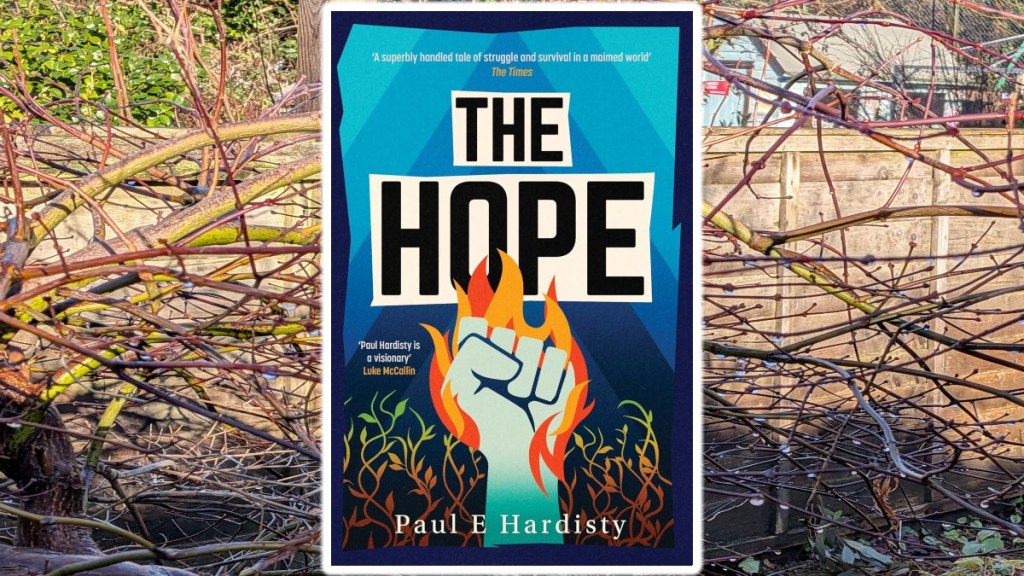
The Hope is the final novel in Paul E. Hardisty’s The Forcing trilogy. I reviewed the first two on GeekDad – and they are both excellent novels. Neither particularly felt like they needed a sequel, and yet both left the reader with a nagging sense that there were more stories to tell. The Hope draws both narratives to a conclusion.
Growing Information:
Plant With: Science Fiction, Speculative Fiction, Climate Apocalypse.
Grows Into: A tale of the best and worst of humanity.
Rating: Vibrant Annual 🌻🌻 (Check here for rating information.)
Available in Paperback from 29th January. (Affiliate Link)
The Review:
Reviewing the third book in a trilogy puts the reviewer in a difficult place. You can’t give away too much of what has come before for people who haven’t read the first two books. You’re reading the book because you enjoyed the first two, and anybody looking to read it, probably enjoyed the first two too, otherwise, why read the third?
If, like me, you enjoyed both The Forcing and The Descent, then you’ll definitely want to complete the trilogy.
If you haven’t read any of the series, then here follows as spoiler-free review as possible.
The Series as a Whole
The backdrop to the trilogy feels very similar to another recent favourite read of mine, Perilous Times. Paul E. Hardisty also treats us to a story containing a credible climate collapse caused by human indifference and corporate greed. The two novels may have similar jumping-off points, but they approach their subject matter very differently.
Hardisty’s books are more about the hard realities of climate change and extrapolating the real-world social and political fallout.
All three books in The Forcing trilogy share a neat motif: the story they tell creates the book you are holding. Each manuscript is crafted during the course of the novel.
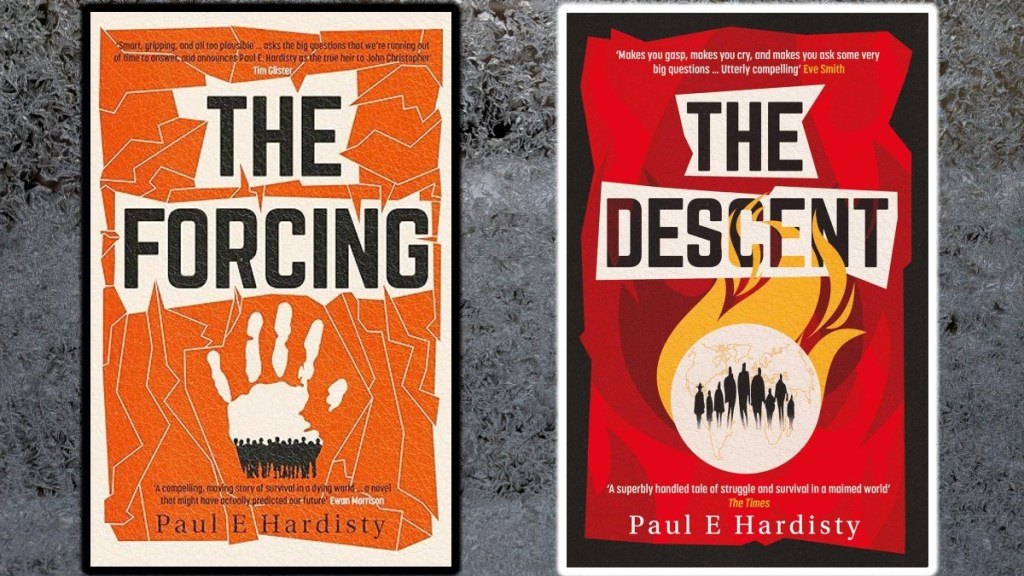
The story in The Forcing begins with a world ravaged by an out-of-control climate collapse, and the rule of an ageing and maniacal despot who becomes President of the U.S.A. – He’s called “Bragg,” though, so this is obviously fiction! The reaction to that becomes “The Repudiation:” A rise of newly elected, young politicians decry the older generation and force them to move into gulags in the overheated centre of the USA.
The resulting aftermath of Bragg’s tearing down of the world order and the wholesale deaths of millions of people form the backdrop of the trilogy.
How does The Hope compare?
Whilst the first two books take place in the same world and one is the continuation of the other, their narratives remain mostly separate. The Hope joins them together and provides some closure for the story as a whole.
What I like about this series is that the individual stories take place in front of a backdrop of future history. Geopolitical events play out with no real beginning or end, in just the same way as our human story does. Episodes that feel like an ending are merely pauses. Human lives carry on regardless. Hardisty captures the ever-rolling nature of humanity’s story perfectly.
I was discussing with my children, last night, how the end of the first world war incubated the conditions for the rise of Hitler, and how even now, 80 years later, a fundamental misundertanding of the Marshall Plan is giving rise to Trump’s foreign “policy.” Hardisty’s novels, and the geo-political circumstances he’s crafted, encapsulate this ripple effect of politics and current affairs.
The Hope is more character-driven than the previous two novels. Its events are smaller, taking place in a much tighter geographical area (Tasmania), with more human problems to solve.
The first two books, being more open-ended, left me wanting more. The Hope, with its closing of narrative threads, did not. Which is not to say I did not enjoy it, or that by the end of the novel, all of the world’s problems are solved, far from it. Yet the smaller story is finished, and I suspect this is the last of the novels in this series that we’ll see from Hardisty.
Having said that, there is scope for more. The world is a large place, and The Hope’s conclusion ends with exactly that, hope. Hope for a better world with seeds sown to bring it back to life. How those seeds fare could be the subject of further novels.
Where The Hope is at least the equal of its predecessors is in its assessment of humanity’s hubris over climate change and its analysis of how absolute power corrupts absolutely.
When reading books, I often turn down corners (I know, a heinous crime) of pages with paragraphs I consider noteworthy. Most books, I don’t turn down any; some, one or two. The Hope has 6.
Some of these are trivial but entertaining, such as when a character finds a post-apocalyptic cache of books by Hardisty’s publisher, Orenda Books (A very worthy cache, no doubt, as Orenda publishes many excellent authors). Others feel depressingly spot on for the times in which we live.
“In its third year of power, the Bragg administration set in motions it’s plans to grow America. US marines landed in Panama and retook the canal. After an abortive attempt to buy Greenland in the same way the USA had purchased Alaska from Russia in 1867, Bragg ordered a full-scale invasion of the island, securing that landmass in a week of realatively bloodless fighting.”
Gulp.
“Books were replaced with AI-generated summaries that were subtly manipulated and gradually made so anodyne as to be meaningless, or worse, misleading. Literacy plummeted all over the world. Unable to understand complex language, people became unable to process nuanced thought. They fell to the old scourges – ignorance, superstition, conspiracy – and the unsubstantiated assertions of charlatans and despots.”
Double gulp.
The Hope is not a novel that shies away from pointing out the precipice on which we stand.
But it is not all doom and gloom. The novel is called The Hope, after all.
So that’s the next big thing I want people to understand. The first was that we allowed ourselves to be distracted by peripheral issues that sapped our available energy, our available outrage. I’ve spoken about that. The second is that there is always a pathway to a better future, even if you can’t see it. You have to keep hope alive. It’s what keeps you going. But you have to have courage in order to hope. You need to be brave.
Reading The Hope (combined with other recent reads Perlious Times and Enshitfication) has made me realise how much I surrender my autonomy to faceless tech and spineless politicians. All three books, in their own way, warn of the perils of waiting for a hero to change things.
When I read the news, it’s hard to feel that any such hero is coming. Books like The Hope remind us that it’s down to the people to change this, as individuals but working as a collective. As I write this review, global events make me feel that the world of The Forcing is only one or two bad decisions away.
Yet there is always hope. Writers and thinkers like Hardisty, the collective defiance of the people of Minneapolis or challengers to the unlawful actions of those in power show us resistance is possible. Yes, it can feel futile, but “they” want us to give up. The Hope is a reminder not to.
Which does all make me wonder whether I need to stop writing this blog – talking about books is hardly going to foment the revolution – but I can make small changes too. Being a gardener adds to my local biodiversity, I can try to avoid using big tech (he says writing on his Mac using Google Chrome – life is full of contradictions.) I can support creativity where possible.
Which leads me to say, read Paul Hardisty’s books, you won’t regret it. Consider what he has to say, and help prevent his vision of the future from coming to pass.
 PotsandPlots
Leave a comment