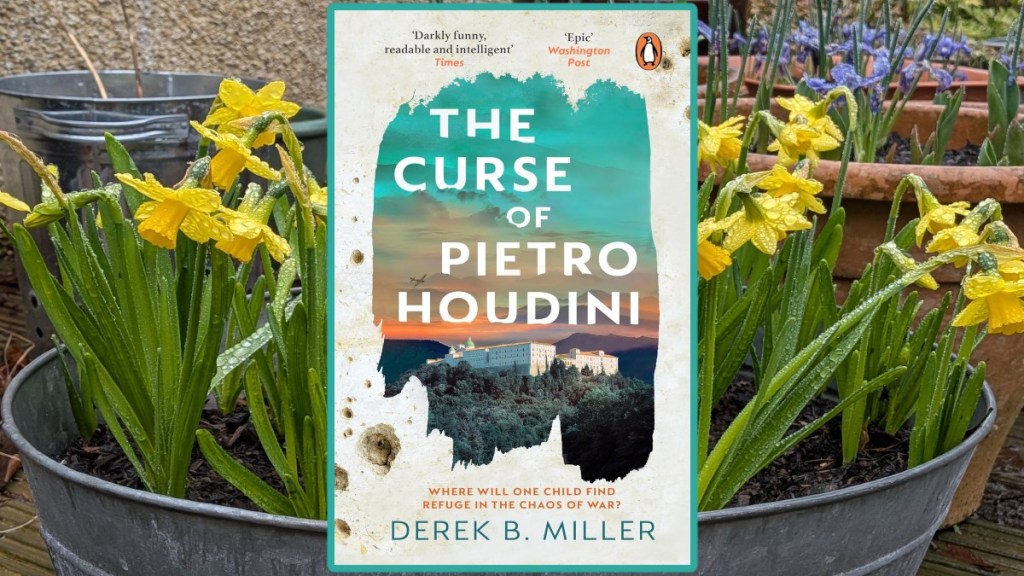
I’ve found my writing mojo deserted me this week, not least because an uptick in the weather means I’ve been out in the garden. (Two days later the uptick has down ticked.) I’ve also been unexpectedly tired, and coherent thought felt beyond me.
Not too tired to read, however, and I’ve devoured a chonky fantasy, the next On the Calculation of Volume, and 200+ pages of the newly arrived Nonesuch by Francis Spufford, since completing The Curse of Pietro Houdini by Derek B. Miller.
Growing Information:
Plant With: Historical Fiction, World War 2, Coming of Age.
Grows Into: An examination of the brutality of war and the bombing of Monte Cassino
Rating: Vibrant Annual 🌻🌻 (Check here for rating information.)
Available now in Paperback (affiliate link).
The Review:
I read Derek B. Miller’s Radio Life when it came out, and I loved it. Seriously, check it out if you love thoughtful SFF. It’s a brilliant novel.
His next novel, The Curse of Pietro Houdini, is an altogether different beast: a historical novel, set in World War II, ostensibly about the preservation of art. This is not in my usual reading wheelhouse, so I was unsure whether to pick it up, but the book kept bubbling to the surface of my consciousness. Radio Life really is that good, so I thought I should give it a try.
I’m so glad I did. I don’t think the book reaches the heights of Radio Life, but that might be because it’s not my typical reading fare. The story is engaging, and its characters, wonderful. It is also harrowing. Based on true events, centred around the bombing of Monte Cassino, this is not a gentle read.
The casual brutality of war is highlighted in the opening pages, when a child, whom we will follow throughout the book, witnesses the death of their parents during an air raid on Rome. They make it to a shelter, but their parents do not.
I’ve deliberately used they/their in the above paragraph because the attitudes and needs of the time mean that our central character has to be several things to different people, including themselves. It’s a powerful motif that Miller uses to great effect, and to say any more, I think, would lessen its impact.
The child ends up in Monte Cassino, which, for those who don’t know, didn’t have Nazi soldiers garrisoned there during the war, but the Allies assumed that it did. Consequently, they bombed it repeatedly, killing 230 civilians who were taking refuge there. As you might expect, the bombing forms a pivotal moment in the book.
The child encounters the mysterious Pietro Houdini, an art restorer, who has been sent by the Vatican to inspect the masters of Renaissance art that are held in the catacombs of the abbey. Houdini is keen to protect the paintings from the circling Nazi soldiers, who have been tasked with rounding up all the artwork for “safekeeping.”
The Curse of Pietro Houdini is about what we don’t know. The fluid gender of the child. What is Houdini’s curse? Is he even who he says he is? If not, who is he, and what happened to his wife? Are the Nazis here to steal the art, or do they really want to keep it safe? Above all, should Houdini and the child leave Monte Cassino? From the vantage of point of 2026, this last question is, of course, a resounding “Yes.”
As the novel progresses, it collects a cast of disparate characters, all with their own motivations and secrets. They’re a ragtag bunch that grows to need and respect one another. It’s this bonding and camaradarie that makes the latter stages of the novel so hard to read.
War, as I said, is brutal. I had no idea of the existence of the Marochinnate, and if I’m honest, I wish I still didn’t. Their arrival deepens the horror that surrounds Houdini, the child and the rest of the players in the novel.
The Curse of Pietro Houdini is a story about the effect of war on civilians. Those who want nothing to do with the fighting yet become caught up in the plans of expansionist leaders. The tragedy of Italy and its annexation by Germany during the latter stages of the war makes it feel all the more terrible. This is a story about human resilience, defiance, but also grim acceptance of impossible circumtances.
The novel was darker than I expected it to be. Pietro is a somewhat comic character, but his lightness of being is often insufficient to brighten the dark events of the story. Pietro is a troubled soul himself. The book does, however, end on a note of optimism that helps balance what has come before.
If you want to read a compelling novel set during World War 2, that puts art, the nature of religion and the power of friendship at its heart, The Curse of Pietro Houdini is definitely the book for you.
 PotsandPlots
Leave a comment