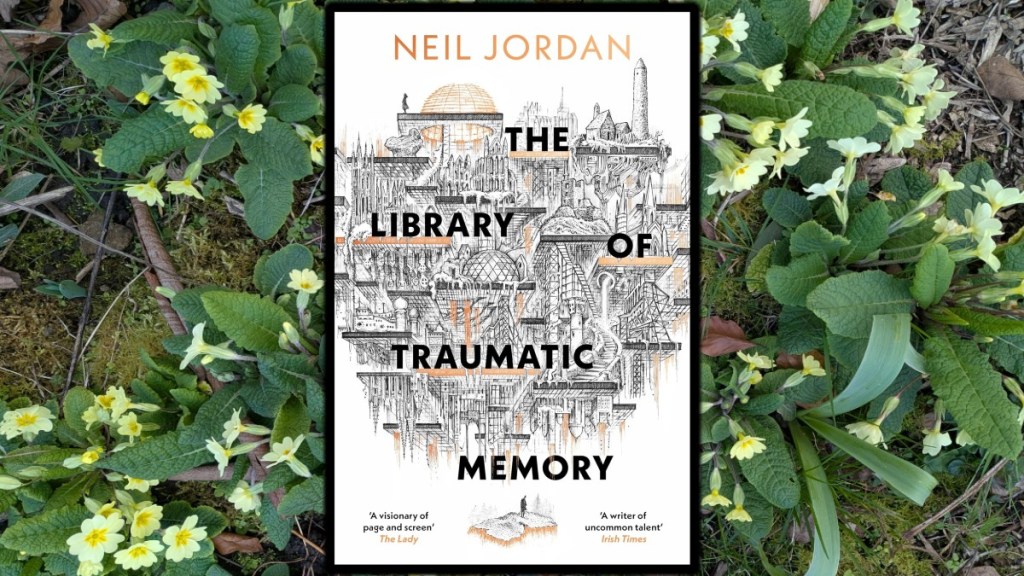
A proof copy of Neil Jordan’s The Library of Traumatic Memory dropped unexpectedly through my letterbox a few weeks ago, and I was thrilled to be given the chance to read it. The acclaimed director of Company of Wolves, The Crying Game, and Interview with a Vampire, surely has better things to do with his time than write a rubbish novel?
Growing Information:
Plant With: Science Fiction, Time Loops, Memory.
Grows Into: An ethereal tale of love, cults and time-bending shenanigans.
Rating: Vibrant Annual 🌻🌻 (Check here for rating information.)
Available now in Hardback (affiliate link).
The Review:
I’m starting to think that Head of Zeus publishes books that I’m not brainy enough to understand. They comprehensively defeated me with last year’s Ice by Jajek Dukej, and I’ve struggled several times with Adrian Tchaikovsky’s Tyrant Philosopher books, though, in my defence, I do love his Dogs of War books that HoZ also publish.
The Library of Traumatic Memory left me almost equally confounded, but I did finish it, and found much to like in it, too.
It’s a book set across time. Part of the narrative takes palce in the 1880s, and the other part, the 2080s. The “action” takes place in a windswept corner of Ireland and follows two distant relatives: Christian Cartwright, a librarian in the future’s Library of Traumatic Memory, and Montagu Cartwright, an architect who designed the local church and the house in which most of the novel takes place.
For me, the strongest parts of the book are in its world-building. The future Ireland (and the rest of the world) felt very real, filled with many oblique references to modern current affairs such as the “Vance Wilson amendments” to the Data Protection Act. My own favourite bit is the idea that cloning “has been outlawed since the Barron Trump multiples and the aborted nuclear strike ordered by the thirteenth Kim Il Jong.”
Technology’s advance has continued apace in The Library of Traumatic Memory, including the ability to store our memories and even overwrite them with better ones. There’s a mysterious Clairvoyance group, and it’s clear as the novel progresses that some terrible and unethical experiments have been carried out at the Institute, Christian’s place of work.
This vision of the future contains the possibility of living on as an avatar after death. Technology that is already being touted today, but in The Library of Traumatic Memory takes on a more codified form.
“Two certainties the Doctor proclaimed. Death and taxes. Let’s introduce them to the uncerainty principle.”
The two time-strands are linked by similar storylines and some peculiar time-loop effects, which I shouldn’t tell you about because it would spoil things, but also can’t tell you, as they’re slippery and elusive, and I’m not quite sure I understood them.
I loved the opening third and closing third of this novel; I got a bit lost and bored in the middle third. Thee are breathy, clandestine love sequences that mirror one another, between the each Cartwright and the wives of their employers. I found these too ethereal to be truly captued by.
I suspect I missed a lot of the novel’s subtleties. It’s one of those books that I feel like I should revist back to figure out what I missed, and hopefully work out exactly what was going on.
The near-future technology outlined in the book is interesting. It’s just enough “other” to feel futuristic, but grounded in enough reality to feel plausible.
Reading The Library of Traumatic Memory, I have the nagging feeling that the SFF literati will proclaim it as a work of near genius. It’s certainly subtle and beguiling. It’s filled with sadness and longing, too.
I wasn’t wholly convinced. While I loved elements of it, the middle section actively bored me, and I was on the verge of giving up. I’m very glad I didn’t, because the the novel’s ending is both interesting and affecting. As my attention wavered in the middle section, I can only rate it 2 sunflowers. This is not a book I would consider keeping on the shelves, year after year.
 PotsandPlots
Leave a comment