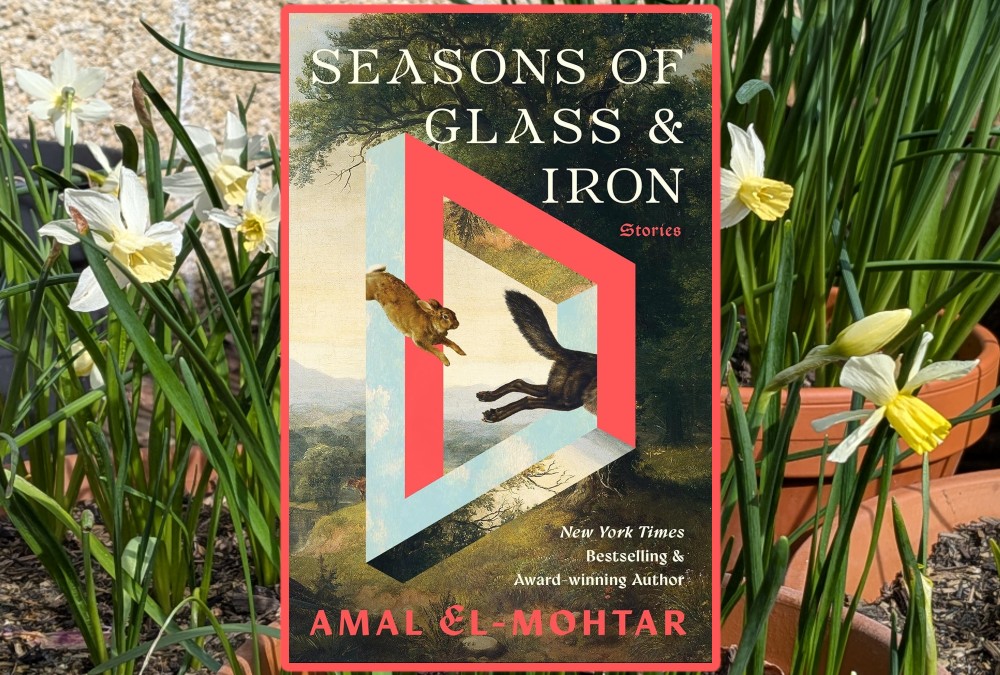
I’m not a great reader of short stories, so I was unsure whether to request this book when the opportunity arose to review it, but the author’s reputation preceded them, and I wanted to check out their work.
For those unaware, Amal El-Mohtar cowrote the highly acclaimed This Is How You Lose the Time War, a book that, at the time of requesting this collection for review, I hadn’t read.
I have now read both that and Seasons of Glass & Iron, and to be honest, I’m not quite sure what I think about either!
Growing Information:
Plant With: Short stories, Fantasy, Shattered Love
Grows Into: An eclectic, sometimes frustrating, often beautiful collection that reframes what stories can do.
Rating: Vibrant Annual 🌻🌻 (Check here for rating information.)
Available now in Hardback (affiliate link).
The Review:
Perhaps because everybody everywhere kept saying how good This is How You Lose the Time War is, I was only ever going to be disappointed. While I loved elements of it, I’m also somewhat embarrassed to admit that I often felt that I didn’t understand what was going on. So much so, I read it twice.
The same ethereal quality found in Time War, unsurprisingly, permeates through Seasons of Glass & Iron. I found sentences and paragraphs that took my breath away with their beauty, as well as sections that I struggled to parse the meaning of.
This is a collection of stories that date back as far as 2008, with only two entries being written in the current decade. All of the stories, I believe, have been published elsewhere. I note that the publisher blurb on the back of my proof copy says “all-new collected” as opposed to “collection,” which feels a little disengunous.
Nevertheless, they were all new to me, so this sleight of hand doesn’t really matter.
The title story is excellent, and I particularly enjoyed the coming-of-age story, “The Truth About Owls.” “John Hollowback and the Witch” feels like a classic dark fairytale, and the closing story “Pockets,” which features transdimensional clothing, is a beguiling story to check out the collection with. These, for me, were the standout pieces, with a couple of others close behind.
Not in Kansas Anymore
I was struck by how different these stories are from most of the fiction I read. Truthfully, there were some stories that I just didn’t enjoy, but the more I read, the more I couldn’t help but feel that it was a “me” problem.
I like to think I’m a compassionate thinker. A man who can see different perspectives and is tolerant of diverse points of view. I like to read widely, and, I thought, from a range of different voices.
Seasons of Glass & Iron made me realise that this probably isn’t true. Many of the stories were challenging. They made me feel uncomfortable. They questioned and upended the assumptions of a cis-het, middle-aged, middle-class, white man, no matter how “right-on” he might think he is.
These stories might not quite be “for me,” but nevertheless, I should bloody well read them, because gaining perspectives from different points of view is always a good thing. The world would be in a much better state if more of us tried to do it more often.
I read at the beginning of the year (but haven’t reviewed) Relearning to Read by Ann Morgan. This book examines how reading translated fiction can help us examine how and why stories are told. How difficult it can be to fully understand a story when you have no concept of how the original language is constructed. It discusses the problems of reading something where it is difficult to insert yourself into the position and culture of the writer.
Seasons of Glass & Iron is not translated, but many of the points made by Morgan remain true. The two combined gave me an appreciation of how much of ourselves we take into the reading experience and how your own presence in a text can inform how you interpret it.
This was very noticeable when reading Seasons of Glass and Iron. It did not feel like a book with a positive outlook on men, which often made me bristle, but thinking deeper, it made me realise even though I read a lot of fiction written by women, very little of it makes me question my maleness. Or, rather, they allow me to keep thinking that I’m a “good guy,” even if the men in the stories I’m reading weren’t.
That is not to say this is a male-hating book. It just made me realise that no matter how much of a good guy, I might think myself to be, there are certain things I’ll never understand, and things that I’ll never have to worry about or concern myself with, as, for me, they will never be a problem. I’ve been superficially aware of this for a long time, but Seasons of Glass made me realise that even though I think I’m aware of my privilege, it goes deeper than I can see or feel.
So, how to rate a book like that? “These stories made me way too introspective – I hate them!” It is hard, I think, for me to objectively say how good they are. They’ve made me reassess what stories can do and even how I relate to what I am reading. This arguably makes the book a hardy perennial (3 sunflowers), but would I want every book I read to be like this, or would I relish reading this book again? Definitely not, which probably, by my own ranking, means I can only give it 🌻🌻.
While I didn’t enjoy all the stories in Seasons of Glass & Iron, many of them left an impression. Beguiling, tantalising and ethereal, they’re unlike almost anything I have read before.
 PotsandPlots
Leave a comment