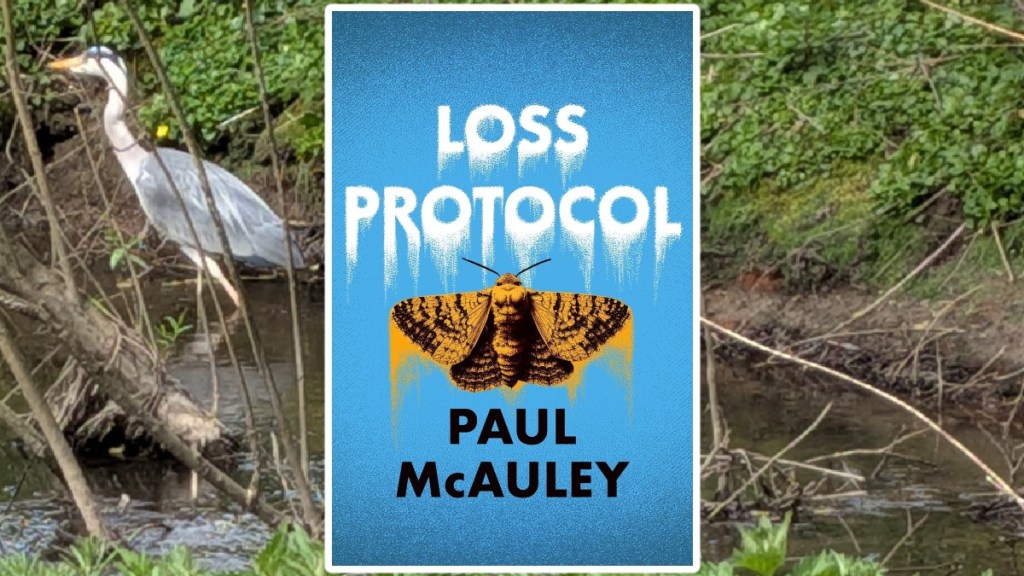
Paul McAuley is a British science fiction author with a substantial backlist. Loss Protocol is the first of his novels that I’ve read, and the strength of the ideas in this one, I’ll be looking to read some more.
While nominally science fiction, I would more define the book as “an emotional eco-thriller, set in a speculative near future.” This might be why I’m never asked to write cover quotes.
Growing Information:
Plant With: Eco thriller, Science Fiction, Psychedelics
Grows Into: A meditation on climate crisis, habitat loss and a world on the brink.
Rating: Vibrant Annual 🌻🌻 (Check here for rating information.)
Available now in Hardback (affiliate link).
The Review:
Loss Protocol is set 50 years or so into the future. The Britain in which it is set is recognisable but has been ravaged by climate change, being filled with overflowing rivers, scorching hot days, and species dieback.
Central character, Marc Winters, is a park ranger who patrols the coastal shores of Essex and the Blackwater River. Winters mostly wants to be left alone, having become notorious after his sister died as part of a cult mass suicide/eco-terrorist operation.
His solitude is shattered, first when a mysterious stranger literally washes up in his patch of land in the nature reserve, and again when somebody breaks into his cabin and covers his boat in graffiti.
“THE INSTAURATION IS COMING”
Hardly the most catchy of slogans – it would look terrible on a hat.
Instauration, for those, like me, who have never heard the word before, means renewing, restoring or renovating, and so very much ties into an ecological philosophy.
Winters discovers that the slogan belongs to a group of “deep dreamers;” people who claim that by using psychedelic mushrooms, they can return to the past to alter the future. This is particularly chilling to Marc, as the cult his sister was part of believed exactly that, too.
Why was his cabin burgled? Is Winters once again going to be dragged into something that he wants no part of? (Of course he is)
A Meandering Mystery
What follows is a thriller in slo-mo. There’s a touch of government manipulation, a dash of cultish charisma, and a soupçon of millionaire interference. There’s a lot of travelling on foot, bikes and boats and many conversations about differing parties that might want a piece of Winters. Through these, we learn how this near-future England runs. There’s space for those with a mission and those with more venal intent.
There are many clashes of culture and ideology now that England has, by necessity, become more self-sufficient. Winters travels from one faction to the next, sometimes by design, other times under duress, and we gradually build up a picture, more a mosaic, of McAuley’s vision of the future.
As a piece of nature writing, Loss Protocol is exemplary. We feel an ecosystem on its knees. The valiant attempts, through rewilding and reduced fossil fuel use, to push back the tide of climate change. The reintroduction of species into habitats gives us hope, but Winters’ story leaves us in no doubt that victories in the battle against species collapse and ecosystem degradation are rare.
The plot, such as it is, is a little nebulous; you never quite know where the novel is going, and even when it’s finished, I wasn’t fully sure where it had been. Thanks to the mushroom-fuelled trances of the deep dreamers, this is undoubtedly deliberate, but I was left feeling like I wanted to understand more.
Yet this nebulous ending feels deliberate, too. The deep dreamers believe that if they return to the past and change the future, only they will remember the path not taken.
The real world stands on the brink of climate collapse, and we can’t know which decisions will improve our future, yet we must make them. Doing nothing, of course, is a decision in itself. Will that lead to the world outlined in Loss Protocol, or something far, far worse? The book makes us confront this question, while offering very few answers.
Loss Protocol is detailed in some areas, nebulous in others. I found the time spent with it fascinating, if occasionally frustrating.


Leave a Reply