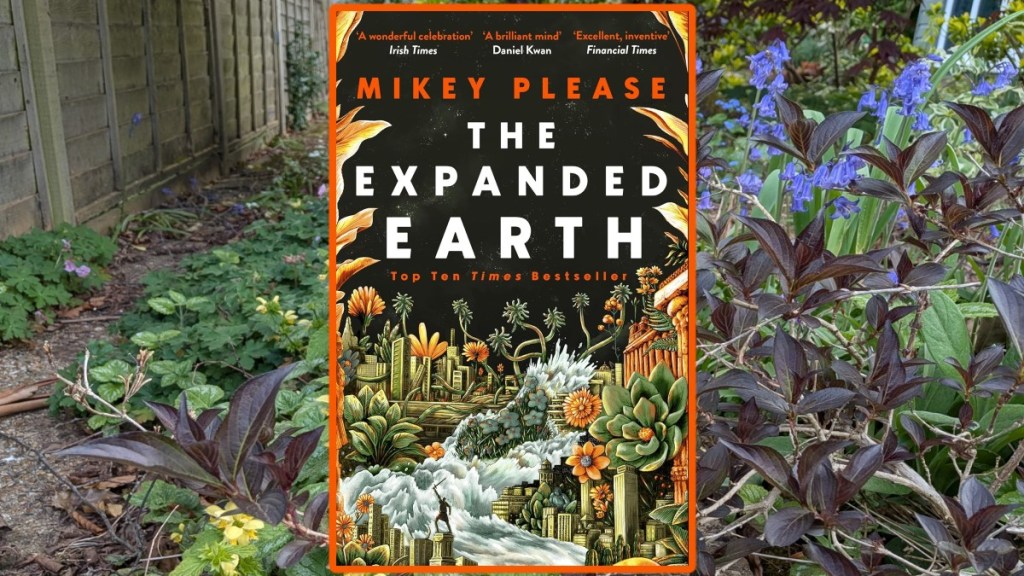
The Expanded Earth is a contender for my read of the year. I loved it from start to finish, and I’m very sad that there’s currently no word on when book two will arrive. I need more!
Growing Information:
Plant With: Science Fiction, Apocalypse, Pastoral Symphony
Grows Into: The most accessible “strange” book I’ve read in a long time.
Rating: Hardy Perennial 🌻🌻 🌻(Check here for rating information.)
Available now in Hardback (affiliate link).
The Review:
The concept of this book is sublime. Humanity has shrunk. Not only in numbers (because lots of us have died) but in physical size too. Roughly down to the size of a hand. The process of shrinking is, more often than not, fatal, because anything non-organic inside you, notably dental work, remains the same size. For obvious reasons, many more children survive than adults, adding a layer of poignancy to the tale.
Those who have survived have become something akin to traumatised Borrowers (if you’ve never read the Mary Norton classics, then I exhort you to do so.) They’re trying to navigate a world in which suddenly everything is gigantic. Things that were once benign are suddenly deadly. Death by crushing is a real possibility. As is death by pet or wild animal. It’s a scary place out there.
One of the best things about the book is its depiction of nature. The cover should have been a giveaway, but I hadn’t expected the novel to be filled with quite so much sumptuous description of fields, plants and gardens. As a gardener, I found it to be another wonderful layer added to an excellent story. The eyes of the miniature humans offer an alternative view of nature, both beautiful and dangerous.
The Expanded Earth contains two central stories. One is set before “the descent” (where humanity shrank), and the other is in essence a quest, where a disparate group of adults is shepherding a gaggle of children to safety. Main character, Giles, is a reluctant helper. All he wants is to try to find his family, yet he can’t leave the people he’s met in the lurch.
This quest aspect of the story is strangely reminiscent of Watership Down. The small size of the questors and Please’s pastoral-soaked descriptions evoke the travails of Fiver and Hazel, especially as it’s filled with wild animals who are happy to eat them. There’s an implacable murderer on their trail, too, offering echoes of the violence in Richard Adams’ classic.
The other thread offers an explanation of how the descent occurred. Hubris and science gone wrong. An eccentric scientist, their research derided, stumbles upon something incredible. This work is appropriated by people who don’t understand its significance, triggering a cataclysm.
These events centre around Matilda, a paramedic, as she tries to cope with, understand and contain the initial shrinking outbreak. The events in this first section set the entire world context, and have unseen linkages through to the post-cataclysm story. The whole piece is artfully constructed.
While these are the two main threads, there is a third strand that is arguably even better. A potpourri of stories from around the world, giving wider context to the tale and showing us glimpses of what is happening away from the main story (which takes place in a narrow strip of England). These chapters greatly add to Please’s worldbuilding. Unlike in some books, where digressions like this feel like an unnecessary derailing from the main plot, I was happy to be diverted, before ploughing on with the overarching narrative.
All Things Bright and Beautiful
The Expanded Earth feels as fresh as anything I’ve ever read. I can’t recommend it highly enough. If the excellent story and evocative descriptions weren’t enough, each chapter concludes with an amazing illustration from Mikey Please. The artwork is stunning. The talented bastard.
It’s funny how children’s books are expected to have illustrations, but slowly, as we age, we’re supposed to put aside such things. My youngest was bemoaning the other day, that the books he reads no longer have interesting pictures. The Expanded Earth doubles as a manifesto as to why all books, no matter what age they’re aimed at, should have pictures.
Curiously, the book also reminded me of Milk Wilks’ Mirroscape books, who is another illustrator/author. I loved those books and Wilks’ Ultimate Alphabet, too. Perhaps the artist’s eye allows a way of seeing the world that I enjoy once it is converted to prose?
This book is the complete package. I loved everything about it. It stretched my imagination, held me in wonder and kept me guessing throughout. If I had to encapsulate why I love books and reading so much, I’d sum it up with a copy of The Expanded Earth.


Leave a Reply