During my early reading years, I had a very monochromatic literary diet. I read epic fantasy, and that was about it. It was only after meeting my now wife (who reads everything!) that things began to change.
Around this time, Jeff Noon published An Automated Alice. Being an Alice fan, I gave it a go and enjoyed it hugely. This then turned me on to Vurt, Pollen, and Pixel Juice. Time then intervened; I hadn’t read a Noon book since. I do have a copy of A Man of Shadows, the first John Nyquist book, but I haven’t got around to reading it yet.
This will have to change, because Moon Over Brendle is a masterpiece, and now I need to go to Noon’s backlist and read some more. (Quite how I’ll make the time, with my current reading schedule, is another matter).
Growing Information:
Plant With: Coming of Age, Creativity, Pastoral Fantasy.
Grows Into: A beguiling examination of youth and the creative process.
Rating: Hardy Perennial 🌻🌻🌻 (Check here for rating information.)
Available now in paperback (affiliate link). Many thanks to Angry Robot Books for sending me a copy to review.
The Review:
I was hesitant when starting Moon Over Brendle. I’ve talked before, about how sometimes, a book, for whatever reason, doesn’t speak to me. I was worried that this “weird fiction” might do this to me again. Weird and magic realism seem to be two triggers for me not “getting” a book.
I need not have worried. Much like Alan Moore’s The Great When, Moon Over Brendle sang to me. The two share similar DNA, though Moon Over Brendle is far more pastoral than The Great When, being set in rural Lancashire rather than post-war London.
Both books are about adjacent worlds and the power of creativity. They both have a coming-of-age feel to them, although Joe Sutter in Brendle is on the cusp of secondary school, rather than making his way in the world as an adult. In this respect, Brendle sits comfortably alongside one of my favourite books of all time, Among Others by Jo Walton.
Here, the two are connected by the innocence of their narrators and a deeply immersive love and reverence for science fiction.
Ah Ooooh, Moon Over Brendle!
I don’t think it says anywhere that you have to sing the title of the book to the tune of Warren Zevon’s Werewolves of London, but I’ve been doing it for at least a week, and am not showing any signs of stopping. It’s a pleasing earworm!
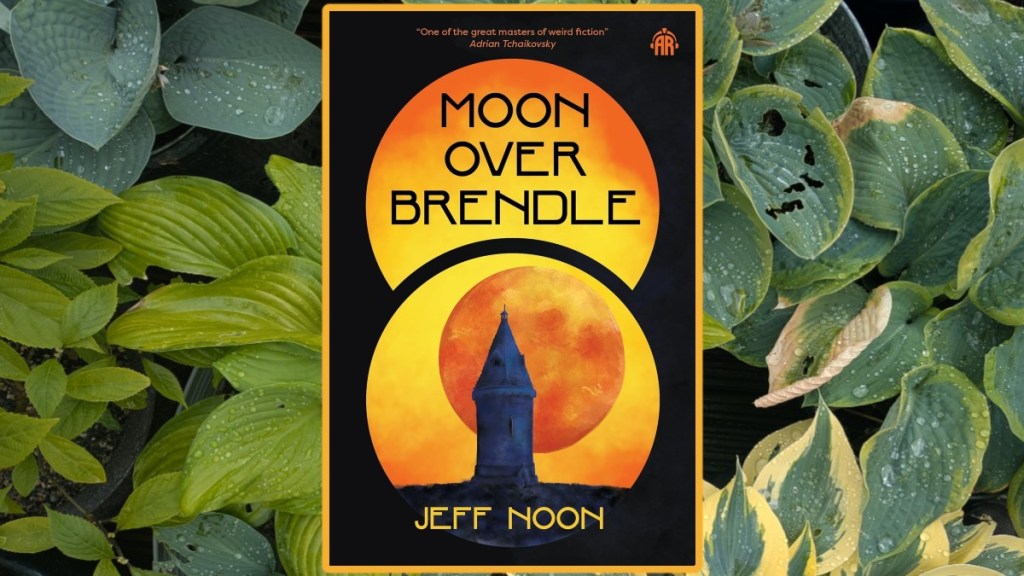
Partway through reading Moon Over Brendle, I was enjoying it so much that I thought I’d post on Bluesky. Looking at the resulting picture, I was struck by how good the cover is. I hadn’t noticed until then how pleasing the alignment of the circles is. It’s a thing of beauty.
Moon Over Brendle is set in a world very similar to this one, in Northern England during the late sixties. The key difference is the presence of “Greot.” This is similar to Dust in Phillip Pullman’s novels (or at least it is difficult not to compare the two.) They both connote creativity and innocence. Through dust, both authors link back to the work of William Blake. I’m sure better-read readers than I could make interesting comparisons and connections between the three writers’ works.
Joe Sutter can see Greot, as can his grandma (a beloved matriarch is always important for these sorts of stories). While Greot is accepted and its existence uncontested, being able to see it is comparatively rare.
As the novel opens, Joe and his friend witness the death of a homeless man. He breathes his last, and Joe notices something peculiar about the Greot around him. This triggers a creative journey that will soon see Joe meeting another ageing man, G. K. Holbrook, a published science fiction novelist.
Holbrook wishes to pass on to Joe the secrets of his writing process, and the novel charts Joe’s journey into a whole new world of invention and creativity. Alongside that, we see the changing relationships between Joe and his best friend Denny, his mother and grandmother, his annoying sister Chloe and his absent father. The book marks both endings and beginnings.
In his afterword, Noon acknowledges the autobiographical nature of the characters and events in the book, albeit with the names changed. It serves as a fascinating insight into his creative process. The iterations, the need to see things differently. One line that struck me, from fairly early on in the book, was the idea that as a writer one should “Solve the puzzle of yourself. Not the problem of yourself, no, but the puzzle, the beautiful puzzle. Do this every day.”
And that, more or less, is what Moon Over Brendle is about.
I don’t feel like I’ve managed at all to convey the majesty of this book, and WordPress tells me I’ve already wanged on for 814 words.
If you’re intrigued by magic-tinged coming-of-age stories, you should read this book. If you’re interested in how stories are constructed, you should read this book, and if, like me, you regularly wonder if you too have a story or two stuck deep inside of you, you should definitely read this book.
Moon Over Brendle is exemplary. I haven’t even begun to describe how moving the final sections of the book are, as Joe grows up and puts away childish things. This rounds the story from coming of age into “come of age,” and makes it all the more powerful. You could read this book for the quality of the writing alone. Its descriptions are wonderful. It’s a book full of heart that will appeal to lovers of fantastic fiction everywhere.


Leave a comment