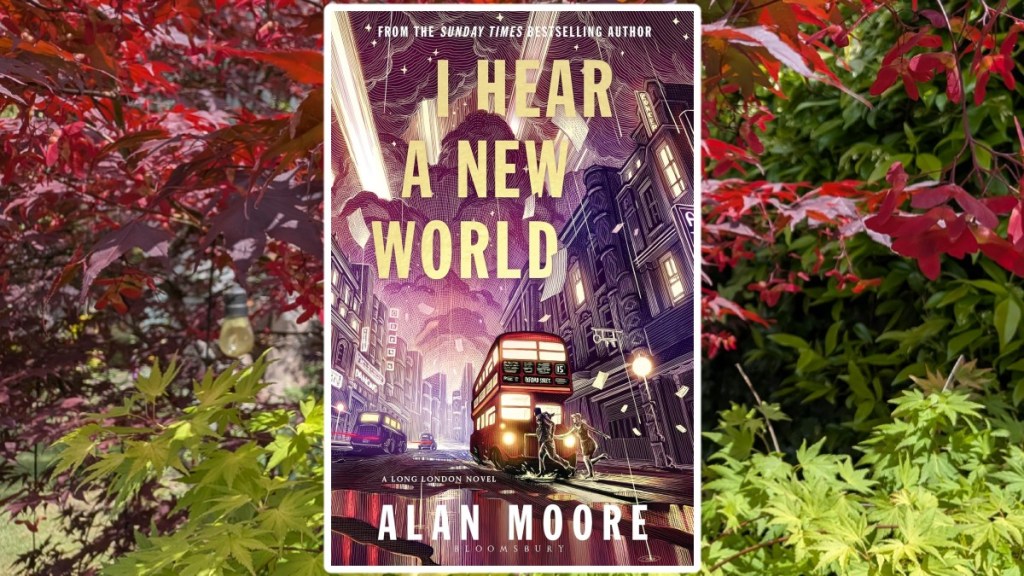
Alan Moore’s The Great When was one of my favourite books of 2025. So keen was I to find out what would happen next, I ordered the follow-up, I Hear a New World, in hardback. Something I rarely do.
Was it worth it?
Growing Information:
Plant With: Speculative Fiction, Occult, Folk History
Grows Into: The second Long London novel featuring music and yet more folk history of the capital.
Rating: Vibrant Annual 🌻🌻(Check here for rating information.)
Available now in paperback (affiliate link).
The Review:
Time has moved forward to 1958, but once again, things in Long London are stirring. Dennis Knuckleyard has done well to put the events of The Great When behind him. Nobody knows the true extent of what he did there to save London from calamity.
When he gives away a key from the other city to Joe Meek, he thinks he is finally shot of the whole place. Instead, this act drags him back in.
The court of Worstminster, is aware of a plot to once again blur the edges between Long London and its “real” counterpart. They want Dennis to ensure this doesn’t happen.
I Hear A New World brings back many of The Great When’s characters, including the inimitable Coffin Ada, and the lovely Grace Shilling. The events of the novel lead up to the real-world death of Ironfoot Jack Neave.
Difficult Second Novel?
I didn’t enjoy I Hear a New World as much as The Great When. I didn’t find the story as involving; there was less narrative drive. Despite being a shorter book, I found it flagged in the middle.
This may be because most of the world-building had been done in the first novel. I now know Long London, and except for the Prime Monster and his court at Worstminster, there wasn’t much added to Moore’s London otherworld. No matter how wonderful a world, your second visit there can never match the first.
In The Great When, there was a greater celebration of art and the artistic process, which, despite Joe Meek being a pivotal character, does not come through to the same extent in I Hear a New World.
Having said that, the last quarter of the book is very strong. Threads that trail through the book knit together, and the reader can suddenly appreciate the depth of Moore’s use of London folklore. There’s plenty of lore on the surface, but a bit of searching on the internet soon made me realise that there are layers upon layers of London history tied up in the book. It’s a folklore fractal.
This, in turn, made me wonder whether, if you were a non-Londoner, you might miss out the book’s subtleties. I’m a suburbanite, but my parents grew up and worked in the city, and told me stories and showed me the sights (and sites) of the old London.
I’m no expert, but I’ve always been interested in the hidden parts of London, and these are the parts that Moore mines in his novels. If I didn’t have that interest, or if I lived in an entirely different country, would the story have the same significance? For the Great When, I’d have said yes. For I Hear a New World, I’m not so sure.
Long London has been conceived as a five-book series that will shift through the decades, culminating in the millennium celebrations. I will definitely be looking out for book 3, and looking forward to the last two novels when Moore turns his attention to a London that I have a more direct experience of, although 1977 (for book four) is right at the limits of my memory!
The main sense one gets from reading the Long London books is the sheer depth of forgotten history out there, waiting to be mined. While Moore’s take occasionally bordered on being too esoteric for my taste, there is no doubting his love for the subject, nor his unparalleled ability to juxtapose the weird and mundane.
As for the Great When, I Hear a New World contains some of the most incredible and evocative descriptions you’ll ever read, with some of the most unlikely similes ever created.


Leave a Reply