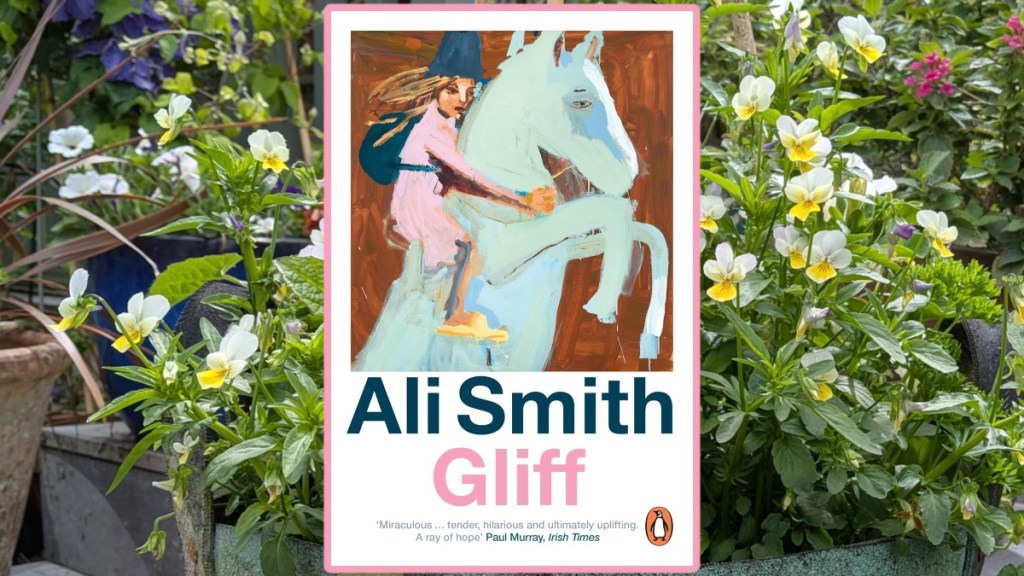
Gliff by Ali Smith is so good I read it twice. It’s a book where you gain the sense of it on the first read, but with a second, and I daresay further reads, you’ll find deeper meaning.
Gliff is a book that keeps on giving.
Growing Information:
Plant With: Speculative Fiction, Authoritarianism, The Power of Language.
Grows Into: A meditation on power structures, control, coercion and freedom fighting.
Rating: Hardy Perennial 🌻🌻🌻(Check here for rating information.)
Available now in paperback (affiliate link).
The Review:
I’m amazed by how much of Gliff I hadn’t remembered, even though only 3 months have passed since I read it. This is worrying on so many levels. Can I trust my memory of anything I have read? Should I start rereading all my favourite books? I can’t, I don’t have time.
Gliff is about power. It’s set in an ambiguous location, an ambiguous time in the future, with an ambiguous hardline regime in charge. It’s a dystopia, with “Unverifiables” and a surveillance state. Oppressive male-centric propaganda permeates the culture. Control and coercion are rife, with language playing an important part in both. Gliff contains echoes of Orwell.
“Does it make it make it easier to control other creatures, or even peoples, us deciding that because we don’t know what they’re saying, what they’re saying doesn’t get to mean anything, or that they don’t get to have a say?”
Bri and Rose have to leave their mother behind and are then, in turn, abandoned by her partner. After they leave their mother in a new job, they discover a red line has been painted around their house, marking them as undesirable.
This is the beginning of the novel’s examination of othering and the arbitrariness of power. The use of lines (in this case, literal ones) that cannot be crossed. Invisible barriers erected to keep sectors of society apart or in their place.
Gliff is about the power of words. How naming things can give power over the named, but also how it’s possible to wrest that power away. The girls, in particular Rose, are forever renaming themselves, recapturing power from their would-be oppressors. Much of the book is about subversion of the system.
“The Deeds Themselves Are Words”
The world Gliff has myriad meanings. This feeds into the fluid nature of the book. Smith has written a companion novel to this book Glyph – described in the back of my book as, “It sounds like Gliff? Well, it’s something else altogether.” This sort of linguistic artifice abounds through Gliff.
Our relationship with technology form another important thread. (I write this review as the government announces the under-16 social media ban, which feels apposite for a book such as Gliff). The idea of the mobile phone as a Tamagochi. Needing to be poked, prodded and maintained to keep it alive; how part of us dies if we fail to do so.
Smith gently probes at the pitfalls of AI – a composite child made by AI from photos. A multi-fragmented mosaic that mirrors how the capture of our data is used to build an aggregation ourselves. Repackaged and used against us.
One of the children Rose and Bri meet has an “educator” watch. It’s a surveillance system and an AI teacher. The irony of the current government banning children from social media, while simultaneously rolling out more and more AI into school is not lost on me.
Online knowledge too is fluid. Can be changed and manipulated. The discovery of a cache of physical books, a permanent repository of knowledge, becomes something close to a religious experience.
Gender fluidity is an important theme of Gliff. This again ties into the power of naming and labelling. Smith examines the differences between naming a human and naming a horse. The liberation of claiming a name for yourself and making it part of your chosen identity.
The slippery slope to authoritarianism and the dehumanising nature of power are both casually slipped into the narrative, with sharp observation and laser-focused prose.
“Keep upping the methodology. Power – It thickens the muscles. It’s red-blooded and it tastes like blood.”
“The Unverifiable are [those who] protest against government, protest again corporations and even protest protest itself.”
Despite being a comparatively easy read, I can see why Gliff could be off-putting. It too is slippery and fluid. It can be hard to gain a sense of story (and I haven’t even mentioned the horse, which adds a whole extra dimension). This is why Gliff needs to be read more than once. The first time to see the structure and narrative. The second to see its layers, the foreshadowing, the depth of its characters and actions.
It’s a quick read. It’s nearly 300 pages, but my edition has large print with lots of section and page breaks. These punctuate the story, giving the reader waystations to take stock of what they’ve read.
I recently reread 1984, which in my opinion has not greatly stood the test of time. It’s turgid in places in a way unacceptable to modern readers. Lots of books claim to be the successor to Orwell’s classic, and while Gliff does not, I can see it becoming a future primer in how the use of language and othering are used to create a dystopian society.
 PotsandPlots
Leave a comment