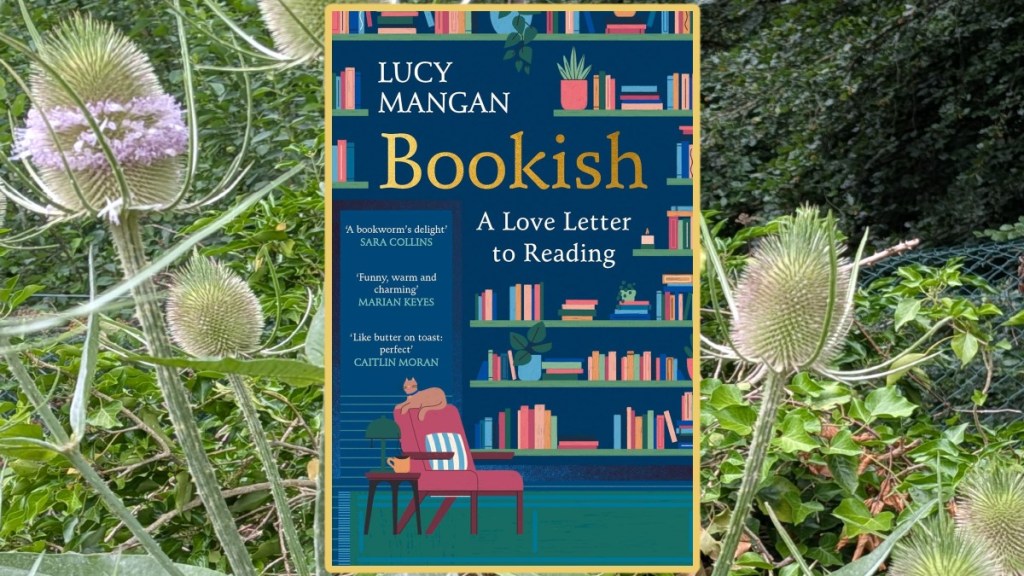
If you love books, you’ll love Bookish.
Especially if you’re in your 50s and middle-class. Like me. It’s an autobiographical tale of Lucy Mangan’s life from her teenage years, through university, her first job(s), marriage and finally, COVID.
Growing Information:
Plant With: Non-Fiction, Book Lovers, Autobiography
Grows Into: An amusing look at a life in books and the affirming power of reading.
Rating: Hardy Perennial 🌻🌻🌻(Check here for rating information.)
Available now in paperback (affiliate link).
The Review:
Bookish is a sequel of sorts. Bookworm, Mangan’s first book on the subject, is all about the books she read as a child. I haven’t read it, but on the strength of Bookish, I will be picking up Bookworm soon.
I read much of Bookish, wondering if my wife might be living a second life as Lucy Mangan. The two of them sound remarkably similar. Introverted inveterate readers. There were a couple of notable differences. Mangan is 5’2″, whereas Mrs P&P is taller than me at 6′. Mangan claims never to have read an Agatha Christie, but my wife has read them all multiple times. We have a shelf in our living room, filled with a set of Christies reissued in the 90s, sporting a particular Art Deco style of cover.
Their reading interests are so aligned that I can’t rule out the possibility that my wife just added these exceptions to throw me off the scent. Mangan is the same age as my wife and trained to be a solicitor at the same time as my wife; the parallels are uncanny.
My wife has a preternatural ability to inhale books, which Mangan appears to share. In my wife’s case, she could parse the dry legal texts that Mangan struggled with, perform exceptionally at her job, and still find time to read twice as many books as I do. A lifestyle that she continues to this day. I probably don’t tell her enough how much I am in awe of her.
Am I Lucy Mangan?
The more I read, the more I had to consider whether it might even be me who unknowingly has a second life as Lucy Mangan. We worked for Waterstones at the same time, me in Guildford, her somewhere in the London suburbs. This forged another personal connection between me and the book.
Mangan talks about the film adaptation cover of I Capture The Castle being in the shop, which was out when I first started working there. I had never heard of it, despite it being by Dodie Smith, who wrote one of my favourite childhood books, One Hundred and One Dalmatians.
Mangan loved One Hundred and One Dalmatians, and is one of the few other people who claim to have read the entirely bonkers sequel Starlight Barking (Even now, I sometimes stop and think about “Clothes that Clank.”). Mangan mentions how much she hates film tie-in covers, and I’m right here with her for that. Her dislike extended all the way to “why bother making films of books at all.” While I take a hard line on covers, I’m not that much of a zealot.
I found the way Mangan talked about the books she’d read, and the sense of place she derives from books and bookshops, absolutely resonated with me. It was like she was writing my own thoughts on the pleasure of reading. The joy of becoming deeply absorbed in a captivating story.
I am perhaps the perfect audience for Bookish. Mangan’s life and circumstances seem very similar to mine. The university anecdotes are set in the same heady days as when I was a student. I very much felt the book’s sense of time and place.
This outlook may not appeal to everyone. Neither will her apparent free pass for JK Rowling’s anti-trans radicalisation. It’s a short paragraph dedicated to Potter, but it’s a hagiographic one.
Like many people my age, who were able to mount the housing ladder when they were young and are lucky enough to be married to wonderful solicitors, Mangan has been largely isolated from many of life’s travails, which, for some readers, may make parts of her story, particularly the COVID-era chapters, difficult to relate to.
That said, Mangan’s description of her father’s cancer diagnosis, revealed while the world was in lockdown, is affecting. As someone who lost both parents during that era, I can attest that she captures the feeling of fear, worry and the forced passivity of accepting whatever happens next.
If you’re looking for book recommendations, then Bookish is the place to come. Mangan writes so fondly about the books she describes that I found it impossible not to want to read them too, even if they’re in genres that I wouldn’t normally touch. Mind you, as a book lover, I am very suggestible.
There are some excellent recommendations of authors and books in Bookish. It provides many months’ worth of book group inspiration. These are handily laid out in a chapter-by-chapter bibliography at the end of the book.
Bookish is a book that will help keen readers find new books. Mangan has read many classics and invites you to give them a try, but she travels down less trodden literary roads, too.
Avid readers will recognise the pleasures that Mangan articulates so perfectly. Put simply, it’s a book by a book lover for book lovers. If you read this blog and have read this far down my review, Bookish is definitely for you.
 PotsandPlots
Leave a comment