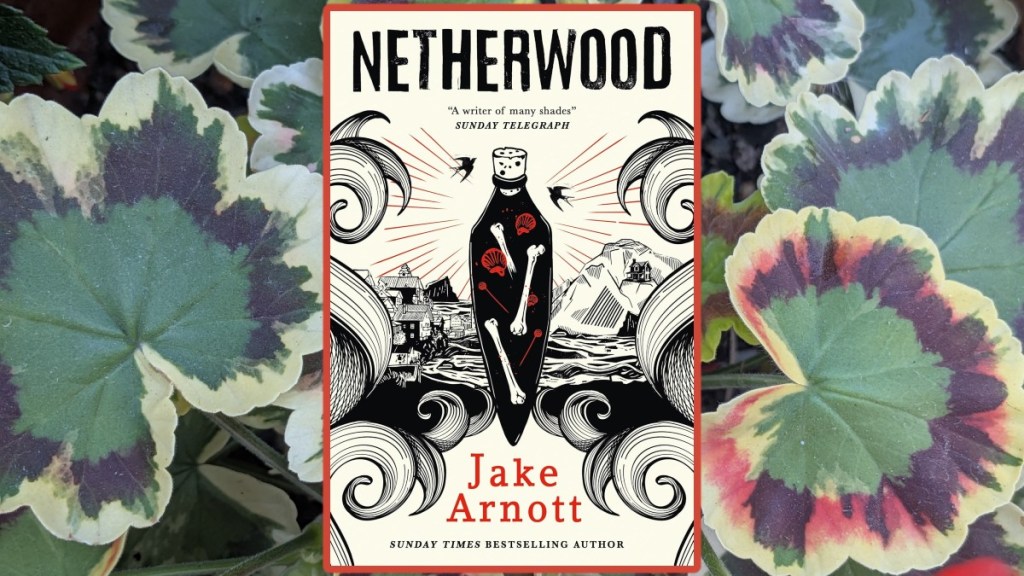
I’m not really a ghost story person. I tend to avoid books branded “horror.” Partly because I’m a little squeamish, but also because I don’t tend to enjoy the type of fantasy that typically runs with horror fiction. (Case in point will be in a future review, Meddling Kids by Edgar Cantero)
I do, however, count Jake Arnott’s The House of Rumour as one of my favourite books. While that’s not a horror story, it does, if memory serves, touch on the occult. I had been considering rereading it when I received an email from the PR team at Titan Books telling me a new Jake Arnott book was on the way, and wondering whether I’d like to review it.
“Hell yeah!” I thought. An unexpectedly appropriate response for the macabre, occult thriller that is Netherwood. Yes, it’s a horror, but also, it’s a new Jake Arnott book.
Netherwood centres around childbirth and includes a miscarriage and potential trauma to pregnant women, so some readers may wish to avoid it.
Growing Information:
Plant With: Ghost Stories, Occult, Macabre
Grows Into: A creepy story infused with questions about the nature of reality and the rise of evil.
Rating: Hardy Perennial 🌻🌻🌻(Check here for rating information.)
Available now in hardback (affiliate link).
Many thanks to Titan for sending me a copy of this book to review.
The Review:
I found Netherwood to be unsettling in places. There is a true sense of macabre when reading the book. It fuses ideas of art and chaos (reminding me a little of Tom Stoppard’s Arcadia) before culminating in a truly unexpected ending.
It centres around a couple, one an artist, the other an art critic, after they buy a house in Hastings. The house, built into the side of a cliff, has an old rock cellar. A cellar with protective wards, in which strange noises can be heard late at night.
Netherwood probes the lines between art and inspiration when Adam, whose career is flatlining, finds a new dark muse to propel his work to new levels. How this connects to the house’s old resident forms the spine of the book’s folk-horror narrative.
Arnott invokes a pantheon of occult figures, most notably Aleister Crowley. Alongside fictional artists, Netherwood brings in real-world avant-garde figures, some of whom had their lives cut short in tragic circumstances, again pushing the theme of dark inspiration.
This is a shortish book. For the first 3/4, I found it an arresting ghost story but little more. Good, but not the sort of thing I would normally read, and not in the same league as The House of Rumour. As the book neared its conclusion, Arnott widened the scope of his story, drawing in a broader tranche of contemporary culture to create something truly arresting.
Suddenly we see how Netherwood fits into a pantheon of heretics and alternative thought. We are offered a new angle from which to see the world, and can’t help but wonder, just a small bit, whether our lives are too mundane. Whether they might be brighter if we added a little more artistic chaos.
If you had told me, partway through reading, how the book would end, I wouldn’t have believed you. I would have said that was not a satisfactory way to leave things. I would have been wrong. I can’t say too much without giving the game away, but Netherwood’s ending felt right and fitting, although still more than a little unsettling.
I found the last quarter of Netherwood utterly enthralling. It spoke to me in the same way as The House of Rumour did, which is definitely staying on top of the to-be-reread pile. Arnott has crafted a book that made me queasy, but despite its macabre facets, made me think differently about the creative process. It does this while examining how the UK’s folk-history sits alongside us, even in this technological 21st century.
If you like horror novels, you’ll love Netherwood, and even if, like me, you’re not hugely keen on the genre, you’ll be impressed by the depth of the story Jake Arnott creates in this slim, unsettling novel.


Leave a Reply