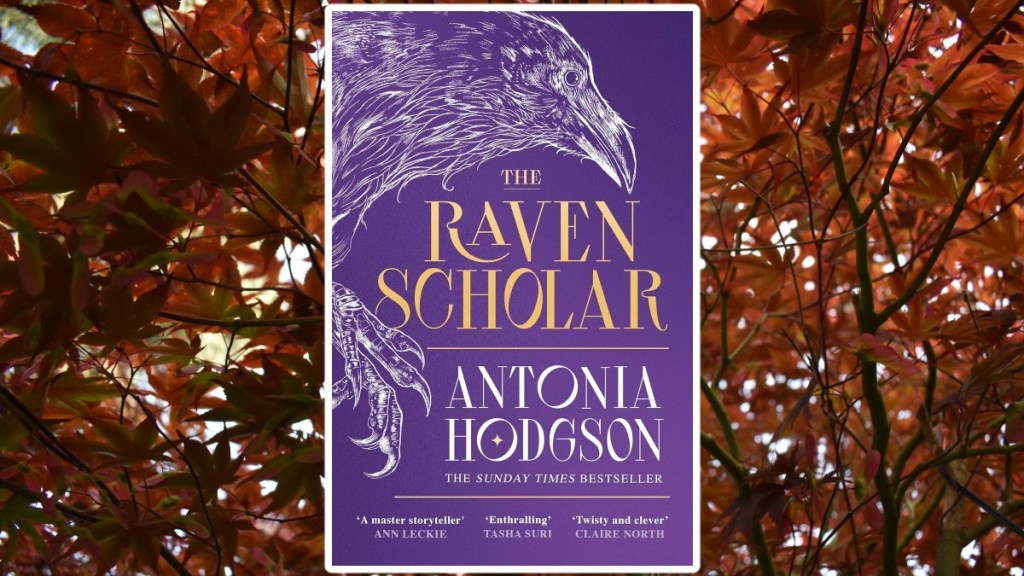
The Raven Scholar was one of my most-looked-forward-to reads of 2026. I’d seen lots of solid reviews, and friends had recommended it too. It has 9400 reviews on Amazon, 70% of which are 5*. Did it live up to my expectations, or did I build up the hype too much?
Growing Information:
Plant With: Fantasy, Tournament novels, hidden secrets.
Grows Into: A last man standing competition, underpinned by tense double-crossing.
Rating: Vibrant Annual 🌻🌻(Check here for rating information.)
Available now in paperback (affiliate link).
The Review:
You can probably tell from the fact I have only given The Raven Scholar 2🌻 that the novel did not blow me away. I enjoyed the time I spent with it, and it certainly had its moments, but ultimately it didn’t “wow” me.
The novel is set up with a fairly classic “last man standing” trial for the throne. In the Raven Scholar world, there are 7 groups that each represent a pseudo-deity. They’re based on animals, with each one broadly represented by an aspect of that animal. The Foxes are cunning, the Oxess workmanlike, and the Tigers proud vicious arseholes. I’ve no idea if real tigers are arseholes, but the Tiger characters in the book definitely are.
Each group sends a representative to what we could call “The Emperor Games.” Neema Kraa is the Raven Scholar – Ravens are the bookish clan in the mix. She is not, as the novel opens, the Raven entrant into the competition.
Neema is unpopular; she literally has no friends. Society in the world of Orrun is very class-based. She is not of noble stock, and was only allowed to be invested into the Ravens because of the modernising current Emperor. She is hated for it. (Neema also has a friend from the mean streets called Cain, who is virtually the embodiment of a Fox – everybody loves him and he plays a major part in the novel.)
The Emperor has taken Neema under his wing in recent years, and her rise within the Ravens and at court has been meteoric. This has made her even less popular. She’s probably the best Raven, but she’s not the political choice to be their entrant to the Great Orrunish Face Off.
For reasons described in the novel’s lore, the Emperor rules for 24 years, then gives up for someone else to have a go. That person is chosen by the process of Animal Gladiators. As is often the way, it’s not clear why a system that has a habit of killing off the brightest and the best became the de facto choice for picking a ruler, but nonetheless, here we are.
I’ve wanged on for quite a bit now and barely covered most of what’s in the novel, and that’s because it’s almost 700 pages long. There’s lots in here, and most of it is very enjoyable. There’s a murder early on, and Neema is tasked with solving who did it, hopefully without messing up the (Who’s Going to Rule the Next) Generation Game.
The novel is filled with a host of interesting characters, some horrible, some considerably less so. The animal deities are interesting, especially as The Raven itself starts to talk and interact with Neema. Having said that, “your animal defines your personality type” may be fine in children’s novels but feels thin here. It’s not ordained by a magic hat, and there’s room for a nature v nurture argument, but it didn’t really ring true.
There are layers and layers of plots and counterplots in the novel, that I’m not even going to begin to go into because it would spoil things. Curiously, Hodgson reveals one of these secrets abruptly, with zero foreshadowing (unless it was subtle and I missed it). The reveal was interesting, shocking even, but this direct intervention in the narrative flow felt like a misstep. And that is where I think my enjoyment began to ebb.
Are You Not Entertained?
Part of the conceit of these tournament novels is that we all agree that it’s probably not the best way to decide who should be given extreme executive power, but we go along with it anyway because these Strictly Come Ruling set ups are fun. The reveal misstep broke the spell. I began to look at the world a bit more closely, and honestly, none of it really makes much sense.
There’s an emperor, but what exactly is he an emperor of, and what does everyone else in the Empire think about it as they go about their days, tilling the fields or fishing the rivers? Not much, I guess. Everything in Neema’s world seems to exist for the sake of the story. The Raven Scholar does not feel like a story taking place in a world that would exist without it.
I enjoyed my time with the book. Enjoyed the reveals, the thrills and the spills, but as the novel finished and I was told there would be another one, I wonder to myself whether I’ll bother picking it. I don’t really feel like I need to know more about these characters, or what might happen to Orrun in the aftermath of the novel’s climax.
Compare this to The Adventures of Amina al-Sirafi by Shannon Chakraborty, a novel of similar length (although the stories are quite different). That novel left me fully invested in its world and characters, and I’m very keen to find out what will happen to them next. Not so Neema and the rest of the gang of The Raven Scholar.
 PotsandPlots
Leave a comment