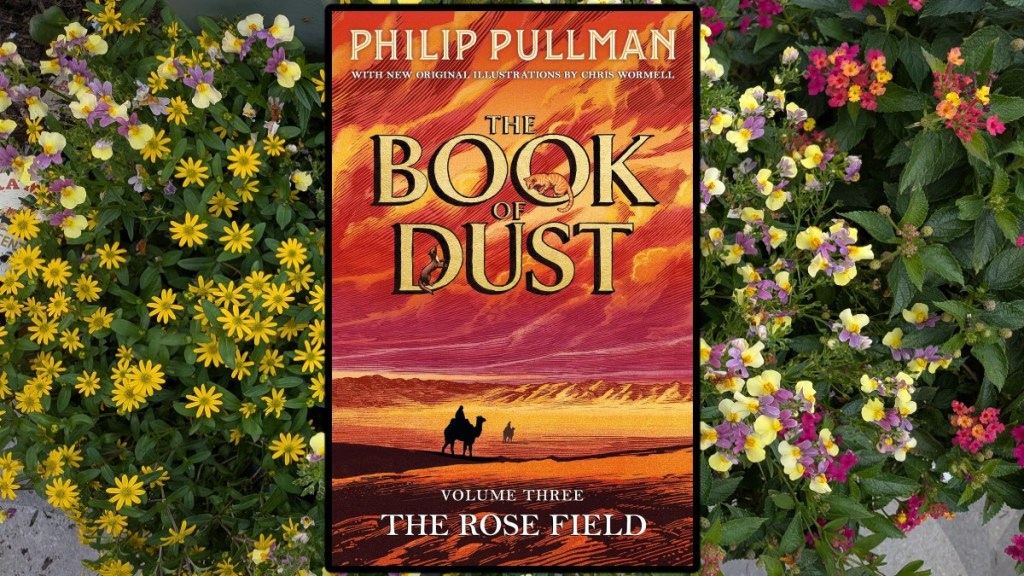
How I wish I hadn’t read The Rose Field. I had been enjoying The Book of Dust up until the end of The Secret Commonwealth. It wasn’t as good as His Dark Materials, but hey, what is?
The Rose Field might as well have been written by a different author. One who has replaced Philip Pullman and is hoping to trash his reputation as a writer of coherent fiction.
Growing Information:
Plant With: Fantasy, Imagination, Pissing Over Your Legacy
Grows Into: An overlong polemic against the dangers of capitalism and lack of creative thoughts.
Rating: Garage Flowers 🌻 (Check here for rating information.)
Available now in paperback (affiliate link).
The Review:
The Rose Field reads as if Philip Pullman wants you to know how clever he is. How much cleverer than you he is. If obfuscating your story so badly the reader loses all interest is a sign of intelligence, then Pullman may well have an IQ in the 1000s.
The book is badly disjointed. Within any given chapter, the narrative jumps back and forth between settings and characters with little warning and often no reason. It’s infuriating. The pacing is all over the place. We should be building to the crescendo of a sweeping story, built across six volumes, yet The Rose Field whimpers toward its final pages, providing almost no imperative for its readers to finish.
The whole book is screaming out for an editor, who I can only assume went on holiday in the months leading up to publishing.
There is some good writing in here. Pullman undoubtedly knows his way around a sentence. Some of his descriptions can still take your breath away, but the story has little urgency and no coherence. New settings and characters are introduced with little or no reason. Old characters return to have side quests that add nothing to the overarching story, just more bloat on an already swollen carcass.
The Magisterium, the long-term villains of the piece, are virtually sidelined in favour of a new megalomaniac leader. His vision is so far beyond his church’s that it almost absolves said church of any responsibility for the events in the book. Yet this vision feels arm-wavy and without root. He’s just very angry about something.
Pullman’s masterstroke in the earlier books, if you read closely enough, is not to attack faith and belief. His beef was with the controlling organisations that use the power afforded to them by their congregations to further their own ends. This phenomenon is no less real today than it was when he first wrote Northern Lights, but in The Rose Field organised religion is left off the hook, to allow a Trump-like figure to take centre stage. I’d say it’s not credible, but perhaps real-life tells me that it is.
The umbrella theme of The Book of Dust trilogy is that imagination is not just the making up of stories, but includes the whole process of creative thought. If La Belle Sauvage was Pullman’s Brexit novel, then The Rose Field rails against large language models, but the creative process needs (deserves) a more coherent argument to defend it.
After reading some 600 pages of The Rose Field, I discover that the main thrust of this volume is that capitalism is bad. That the constant search for growth is unsustainable. Gee, thanks. I would never have realised. It’s an argument made far better by many writers of fantasy, science fiction, and of course, economists too. With the money you’ve saved not buying The Rose Field, buy Donut Economics by Kate Raworth instead, which makes a far less rambling, more cogent argument on the subject.
I don’t really understand how the people involved in The Rose Field felt that it was in good enough shape to release to the public. Perhaps there was a time imperative. Perhaps the long gap between The Secret Commonwealth and The Rose Field meant that I fell outside its magical slipstream. It was certainly difficult to remember the minutiae of the preceding volumes. Yet, a Pullman at the height of his powers would have swept me up and carried me to a conclusion that would have sung of its convictions. This half-heartedly pushed me in the direction of the end, relying on loyalty to the series and to my book club, with whom I was to discuss the book. Without those, I’d have given up only halfway through.
A sad end to (what should have been) a brilliant series.
 PotsandPlots
Leave a comment