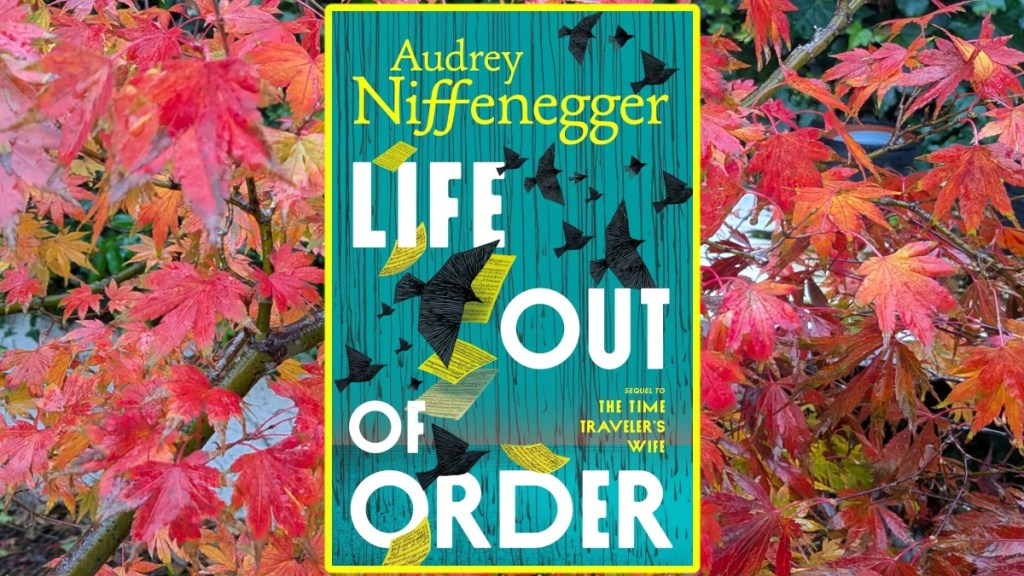
Life Out of Order is a direct sequel to The Time Traveler’s Wife, and while you could read it without reading TTTW first, I wouldn’t recommend doing so. TTTW is wonderful, and if you haven’t read it, you definitely won’t regret doing so.
I say it’s wonderful. I remember absolutely loving it, but on reading Life Out of Order, I’ve realised I don’t remember much about it. I really need to pick TTTW up again to remind myself what happened.
I wasn’t expecting Life Out of Order to be in the same league as TTTW, particularly after not loving Her Fearful Symmetry. While Life Out of Order did not move me in the same way as TTTW, I found it both absorbing and thought-provoking.
Despite ending with a modicum of hope, Life Out of Order is a bleak novel. A melancholy meditation on ageing and, worse, an excoriating polemic on the parlous state of the world.
Growing Information:
Plant With: Love, ageing, and the end of the world.
Grows Into: A complex tale of lives interwoven. Bleak, unflinching, but ultimately hopeful.
Rating: Hardy Perennial 🌻🌻🌻(Check here for rating information.)
Available now in hardback (affiliate link).
The Review:
I don’t remember this about TTTW, but with its jumping timeframes, it is hard to tease out a coherent narrative for most of Life Out of Order.
It follows Alba, the daughter of Henry and Clare from the first book, who, like her father, randomly travels back and forth in time. As the book opens, Alba is in her early twenties, but we will see her at multiple ages across multiple time frames.
We see Alba coming to terms with living without a father, and her mother, Clare, living without her husband. We know from the outset that time-travelling Alba will have two husbands, who across time do not know each other. In one sense, this is a story of how those two loves play out, as Alba blinks in and out of existence.
The other core strand of the novel is the creation of Isadora, who, as the novel opens, is a ring-fenced AI. Isadora will be allowed to age as though she were a real child. We will see her development in a fragmented fashion as Alba jumps back and forth.
Oliver, one of Alba’s husbands, is also a time traveller. Through him, we know that Isadora and at some point will be part of a paradigm shift that will change humanity.
Through fragments and jumps, we piece together a mosaic of Alba and her family’s stories. Life Out of Order shows us their losses and triumphs. The book meditates on the nature of love and art; it’s filled with characters with complicated relationships who love music and the creative process.
It can be hard to see which direction the novel is heading, beyond a sense of foreboding that things aren’t going to end terribly well. If you like to have a firm destination in mind when reading, you’ll probably struggle with Life Out of Order. We are treated to little snapshots and vignettes of Alba and her family’s life, but what’s it all adding up to?
This doesn’t become evident until the last fifth of the book, when we spend more time in the future. More time with Isadora, Alba and her two husbands. Niffenegger offers us a story of a world controlled by oligarchs and despotic leaders. It’s veiled, but it’s there. Her disillusionment with the 2016 and subsequent American election results is evident.
This is a proudly diverse novel, with characters that feel almost transgressive in 2026. A deeply disturbing feeling that reveals how much progress has been lost in recent years.
Climate change forms the overriding narrative of Life Out of Order. Niffenegger proposes a world that will collapse in a relatively short time. A timeline in which I will be dead before its conclusion, but one that my children will live into. That is a profoundly depressing thought.
More depressing is the powerlessness Life Out of Order engenders. It lays bare humanity’s selfishness; nations’ desire to look inwards, rather than collaboratively. This ultimately leads to the civilizational collapse depicted at the end of the novel.
This feeling is exacerbated through the gradual ageing of each of the characters, seen through the teleporting Alba. The older the characters are, the less in touch with the world they become. With ageing also comes death, which deepens the novel’s sense of melancholia.
Interwoven between this is Isadora and speculation about the evolution of AI. Life Out of Order took many years to write, and I imagine the continual shifting of the real-world political and technological playing fields must have made committing to a final draft a difficult prospect. Niffenegger, I think, nails it. It’s a bleak future, but as I sit typing towards the end of 2026, it feels like an uncomfortably realistic one.
I mentioned at the top of the review, despite its bleakness, Life Out of Order ends with a glimmer of hope, but perhaps the real hope is that it was written and published at all. In a world where tyranny feels just around the corner, where hard-won freedoms are being eroded, the mere fact that somebody felt compelled to write a diverse, inclusive novel is to be celebrated
That a publisher feels it is worth publishing something that rails against tech oligarchs and the small humans with despotic tendencies we seem so keen to give power to is in itself cause for hope.
That hundreds of thousands, if not millions, of people want to read and enjoy such a book is cause for optimism. Whether these people can unite to hold back the tide and prevent the world described by Niffenegger from coming to pass remains to be seen.


Leave a Reply