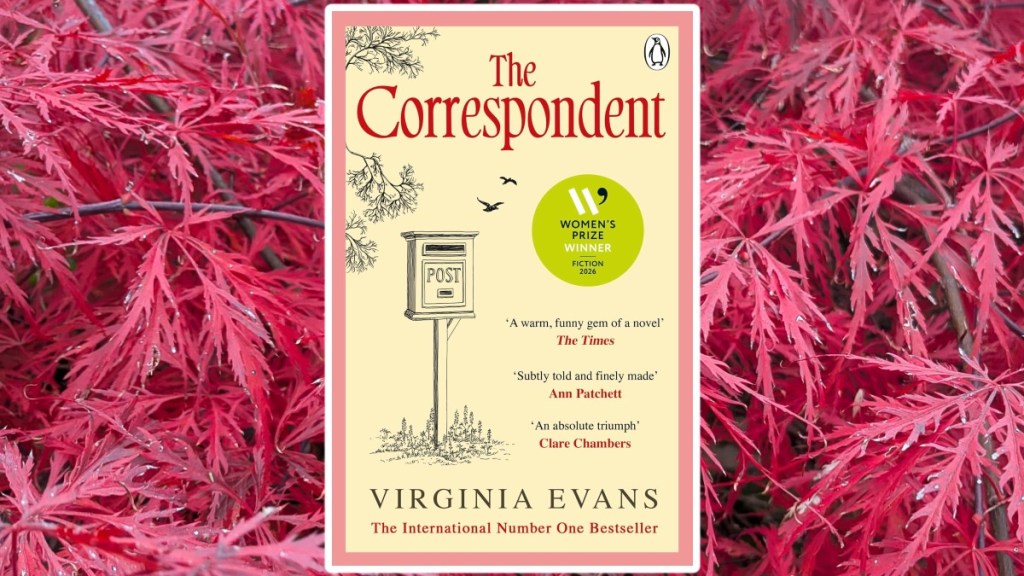
Continuing my further adventures in reviewing books that don’t need reviewing is Virginia Evans’ The Correspondent. It has almost 180,000 reviews, 2/3 of which are 5*.
I didn’t unreservedly love The Correspondent, but I did enjoy the time I spent with it. I feel slightly guilty only rating it 🌻🌻, but while I didn’t find a great deal wrong with it, it wasn’t a book that left me glowing or desperate for more.
Growing Information:
Plant With: Epistolary novels, Growing Old, Bittersweet.
Grows Into: A meditation on lives well-lived, mistakes made, and opportunities missed and taken.
Rating: Vibrant Annual 🌻🌻(Check here for rating information.)
Available now in paperback (affiliate link).
The Review:
Feedback from the two book groups I read it for was curiously mixed. I found myself to be among the people who liked it most, despite not being totally blown away by it.
Many people didn’t like the epistolary structure. The book, and by extension its characters, are seen only through letters. This sets up stilted access to the narrative that many people found off-putting. The main reason for readers’ dislike is that Sybil, our main letter writer and the hub of the novel, is not especially likeable. It takes a long time for her to grow into a sympathetic character.
I felt these things give the novel its strength. I liked the stilted view. Many novels have omniscient narrators. We often know characters’ interior monologues. We mostly see only Sybil’s reactions to events read via her writing about things she’s read. Long-distance conversations carried out via a medium that, by its nature, promotes caution. Her responses are filtered responses to filtered responses.
I enjoyed the way Evans examined the benefits and limitations of letter writing, and the fundamental differences between putting pen to paper and sending an email.
Sybil mentions that she prefers the control that letter writing gives you, but as we read the novel, we see that a letter tends to only crystallise one point of view at any given time. Nuance is hard. We also cannot guarantee how the written word will be interpreted. Anybody who has continued an argument with a close relative via the medium of email or text will know that if the recipient can misinterpret what you’re saying, they probably will. Or perhaps I’m just terrible at written communication.
There is one thorny problem in particular that Sybil can only solve when she has face-to-face contact with the person she is bickering with. I liked this dimension of the novel. Sybil may have been prickly, set in her ways and not fond of interacting with people except through letters, but over the course of the novel she grows. I liked that The Correspondent shows how personal growth is possible even in our twilight years.
Sybil is austere but the book is funny and warm in places too. While Sybil’s life story has dark undertones, there are moments of genuine humour, both intentional on Sybil’s part, and some entirely by accident. Of course, all the jokes were deliberately crafted by Virginia Evans.
There is tragedy at the core of Sybil’s life, and as the letter writing continues, we learn more about it, and the fractured relationships that it subsequently caused. We see the deep ripples and undercurrents that the loss of a loved one can bring. Again, this is well crafted by Evans.
Over the course of The Correspondent we begin to feel more sympathy for Sybil. We understand how she became like she is, and why cocooning herself away from the world, trying to only interact through the pen, might have felt like a better option.
This review has taken an unexpectedly long time to write. It’s now nearly a month since I finished the book. I started its opening lines 4 weeks ago, and now, as I write, I find myself curious that I thought it only worth rating it two sunflowers. The things I didn’t enjoy about it have faded into the background, leaving me with an impression of the central core of a novel that is heartfelt and artfully constructed.
I haven’t edited my rating, so that you can perhaps see the journey my thoughts have taken. Even though there is much to admire in The Correspondent, I didn’t find myself utterly gripped. It is still not a novel I would hurry to read again. Nevertheless, as a meditation on the power of the written word, of ageing and of loss, it is a novel with very few equals.


Leave a Reply