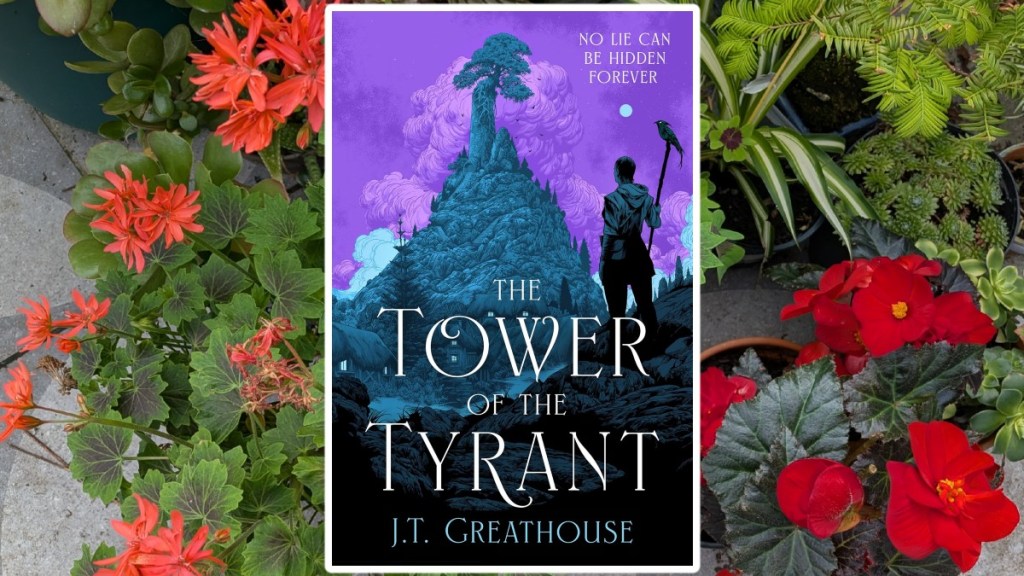
I don’t feel I fully did The Tower of the Tyrant justice. I started it on holiday, but it’s a dense tome that requires close reading. I was running out of time to read my two book group picks before their respective meetings, so I had to pause The Tower of the Tyrant partway through.
After wading through the execrable The Rose Field, I wasn’t sure I ever wanted to read again. Against this background, I reentered The Tower of the Tyrant, and because of its quite complicated themes and politics, I found myself a little at sea.
Nevertheless, I found my way back into this quietly absorbing tale that examines the cultural trauma created by bloody conflict and conquest.
Growing Information:
Plant With: Fantasy, Complex World Building, Cultural Trauma
Grows Into: A thought-provoking examination of the effects of conquest on the descendants of a society.
Rating: Vibrant Annual 🌻🌻(Check here for rating information.)
Available now in paperback (affiliate link).
Many thanks to Gollancz for sending me a copy to review.
The Review:
It is perhaps ironic, considering that I interrupted The Tower of the Tyrant to read Philip Pullman, that the two novels share some DNA. Most notably, the dogmatic knights of “The Mortal Church” share many attributes with The Magisterium.
Torin and his band of not-so-merry men and women form one spoke of villainy in the book. They are very much against magic, apart from their own, of course. They’ll stop at nothing to eradicate the fey-influenced magic that imbues much of the realm.
Fola is the exact opposite. She’s essentially a philosophy wizard. Fola is on a tour of Parwys, far from “The City,” where she lives. The City is a Utopia, where everyone is free of fear and able to pursue just about any line of intellectual enquiry they fancy.
The third pillar of the book comes from the magic that imbues the land. It manifests in several different ways during the story, most notably via druids and Lanwyr, one of The Tower of the Tyrant’s central characters, who is essentially a forest-born revenant.
If all that magic, religion and philosophy swirling around didn’t add enough depth and complexity, Parwys lives in the shadow of the First Folk. Mysterious superbeings lost to the mists of time. Oh, yes, and the undead are pretty commonplace too.
Parwys is a land familiar with the restless dead, and it is the violent haunting of the Kings of Parwys, that drives the narrative of The Tower of the Tyrant. Fola thinks she can discover the nature of the hauntings, allowing the king to live in peace, while also unravelling some First Folk mysteries. This will raise her status in the eyes of her mentors back in the city.
The Tower of the Tyrant is steeped in insecurity. It provides insight into how many actions are driven to assuage personal insecurities. It explores how those actions can have devastating knock-on effects, on a personal level, but, even more deeply, if the insecure find their way to power. Nobody actually tries to build a triumphal arch that bristles with machine guns, but it’s an implied consequence of letting weak men rule a nation.
This is a deep read. The history of Parwys becomes integral to the plot and nature of the hauntings. The scope broadens out to examine the long-term effects of conquest. How even when things are settled, generations after armed struggle, the effects are felt deeply by both winners and losers. Resentment that festers, or a superiority that cements itself into the psyche. Against that backdrop, continue several stories of rediscovery and personal salvation.
Not everything worked for me. The City felt too Utopian. It sounds like a daft thing to say about a fantasy novel, but Fola, The City and its magic didn’t feel real enough. I found it hard to believe that such a place could truly exist in the same world as one as primal as Parwys. It’s almost literally an Ivory Tower, which I guess was the metaphor that Greathouse was going for, but, even though he hints that all is not rosy inside the city, I found it too perfect to be effective.
The story was abosrbing rather than propulsive, although I was gripped during the novel’s final chapters. The ending was unexpected, adding to the sense that this is not ordinary fantasy fare.
My reading of The Tower of the Tyrant definitely suffered for my enforced break. This is a novel that requires energy and effort to wring the best out of it. My hiatus broke the threads I had established in the first half of the book, and I had to work again to rebuild my understanding of what Greathouse was trying to do. I’m not entirely convinced I still fully understand. This is a book with many nuances.
Many people read fantasy to escape from the real world. This book does not allow you to do that. This is not light escapism. Its themes hit deep, asking you to consider a wealth of human emotions and motivations. While it does ask a lot of its readers, it repays those efforts. The Tower of the Tyrant shifted my expectations as to what fantasy can do, taking worldbuilding in a direction I’ve yet to encounter. I did not love The Tower of the Tyrant, but I do admire it deeply.


Leave a comment