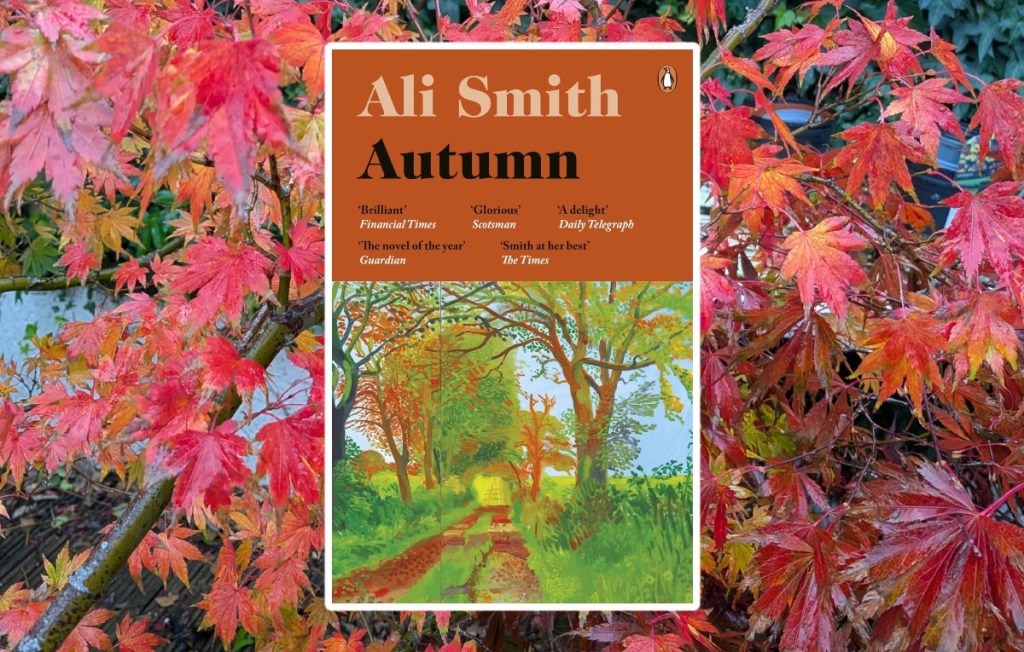
Time certainly flies. Reading the Seasonal Quartet by Ali Smith has been on my wishlist for a while now, but I had no idea that this first instalment, Autumn, was published in 2016, which, remarkably, is 10 years ago.
Let’s just say it’s aged a lot better than any oven-ready deal.
Growing Information:
Plant With: Autumn, Family, Ageing
Grows Into: A wistful examination of growing old, Brexit and family bonds.
Rating: Hardy Perennial 🌻🌻🌻 (Check here for rating information.)
Available now in paperback (affiliate link).
The Review:
Earlier this year I wrote about my misconception that the Seasonal Quartet could be read in any order. After an aborted start in the Spring, it was great to finally start Autumn. It has cemented Ali Smith as one of my favourite authors. It’s not yet clear how the books make a quartet, as Autumn feels self-contained. I’ll have to wait until Winter to find out.
Autumn is set just after the 2016 Brexit vote and follows Elisabeth, who is in her early 30s, and Daniel, who is 100. Daniel was a Jewish refugee who arrived in England in the 30s. He’s now seeing out his final days in a care home. The two were neighbours when Elisabeth was a young girl. Through a small sleight of hand, Elisabeth is listed as Daniel’s next of kin and visits him regularly.
The book’s narrative time frame jumps around. It moves back and forth from Elisabeth’s childhood to the present day, but also to various points in Daniel’s earlier life. It shows us how he encourages Elisabeth to see the world differently. Elisabeth will become a history of art teacher, and the two share an affinity for the artist Pauline Boty.
I was only vaguely aware of Boty before reading the book, and it serves as a great jumping-off point for learning about “Britain’s Only Female Pop Artist.” Her life and work are a key feature of the book, which very much deals with “ways of seeing.”
Smith’s writing style in Autumn makes for comfortable reading. The experience was very like reading Gliff, so much so that at times I had to remind myself the books aren’t related. The prose in Autumn has a reality-adjacent feel. Otherworldly, while at the same time, absolutely skewering the absurdities of everyday life, such as trying to renew your passport at the Post Office.
However, it already feels slightly dated. Small things have moved on since Brexit; we’ve all been scarred by the bruising shifts taken by social media as they pit us against one another for clicks. Tasks such as going to the Post Office have largely moved online, and an open Post Office has even become a luxury.
The confusion, anger and despair about Brexit still ring true, however. Autumn is becoming increasingly relevant now as Andy Burnham tries to reframe our relationship with Europe. In response, the Right loses its collective shit at the thought that somebody might try to polish the Brexit turd they left on the nation’s doorstep.
“Then the other spokesperson in the dialogue said, well, you would say that. Get over it. Grow up.
Your time’s over. Democracy. You lost.
It is like democracy is a bottle someone can threaten to smash and do a bit of damage with. It has become a time of people saying stuff to each other and none of it actually ever becoming dialogue.
It is the end of dialogue.“
Dialogue still feels depressingly far away.
“Her mother sits down on the churned-up ground near the fence.
I’m tired, she says.
It’s only two miles, Elisabeth says.
That’s not what I mean, she says. I’m tired of the news. I’m tired of the way it makes things spectacular that aren’t, and deals so simplistically with what’s truly appalling. I’m tired of the vitriol. I’m tired of the anger. I’m tired of the meanness. I’m tired of the selfishness. I’m tired of how we’re doing nothing to stop it. I’m tired of how we’re encouraging it. I’m tired of the violence there is and I’m tired of the violence that’s on its way, that’s coming, that hasn’t happened yet. I’m tired of liars. I’m tired of sanctified liars. I’m tired of how those liars have let this happen. I’m tired of having to wonder whether they did it out of stupidity or did it on purpose. I’m tired of lying governments. I’m tired of people not caring whether they’re being lied to any more. I’m tired of being made to feel this fearful. I’m tired of animosity. I’m tired of pusillanimosity.
I don’t think that’s actually a word, Elisabeth says.
I’m tired of not knowing the right words, her mother says.“
Anybody who has been paying attention for the last 10 years will sympathise with the sentiments of these passages. They sum up exactly how I feel about Brexit and politics that followed.
Smith melds politics and culture seamlessly, exploring how they each inform the other. Her books make you more curious about the world and why it’s like it is, whether that be the language we use, the politicians we elect or the artists we admire. I’m constantly surprised by how she can make me reassess how I look at things.
As with Gliff, after finishing Autumn, I wanted to turn it back over and start reading it again. Smith’s use of language gives her work many layers, and after parsing the central themes and main narrative on the first reading, there’s a strong desire to go back, reread and look for deeper meaning. Perhaps I shall try to do this before I read Winter.
I thoroughly enjoyed reading Autumn. I loved basking in the skill of the author’s writing, and I can’t wait to read more. Whether that be Smith’s new work (I’m looking forward to Glyph at the start of the next year) or continuing with Winter and the Seasonal Quartet.


Leave a Reply